
Tracking Dukes County Recent Arrests
The Dukes County Sheriff's Office runs the Dukes County Jail and House of Correction. A regional lock-up serves the six Martha's Vineyard towns. The Sheriff's public website posts no name-search roster. There is no booking table, photo gallery, or update schedule. That gap shapes any careful search for Dukes County arrests. A town police entry shows the local event. A call to the jail answers who is in custody today. A written request can reach a booking file. After arraignment, the case moves to the Edgartown District Court or MassCourts.
Sequence matters here. Arrest, transport, jail intake, court appearance, release, and transfer are all separate steps. Each may leave its own trace. A name in a town log may never show up in any county list. No such list is published. A released person is no longer held, though the arrest record itself may survive. Each window answers a different question:
| Window | Official path | What it establishes | What it cannot establish |
|---|---|---|---|
| Same day | DCSO at 508-627-5173 | A current-custody inquiry under agency rules | A live list, photo, posting time, or exact delay |
| Several days | Town police logs | Selected dated police activity | Countywide bookings or continued jail custody |
| After arraignment | District Court and MassCourts | Public complaint, bail, scheduling, and disposition data | A jail intake photo or complete narrative |
| State sentence | Massachusetts DOC and VINELink | Covered state DOC custody status | Fresh Dukes County bookings |
For same-day detail, see Arrests Last 24 Hours. The Police Blotter page covers the town-log and archive approach. Both lead to source records rather than lists of accused people.
From Town Arrest to Regional Lock-up
An arrest in Oak Bluffs, Edgartown, or Tisbury starts with the town police. Those departments report their own activity in their own ways. None of them runs a jail. Instead, anyone held locally goes to the regional lock-up. The Sheriff runs it at the Dukes County Jail and House of Correction. So the paper trail splits in three. The town logs the police event, the Sheriff logs who was accepted and released, and the court keeps the case file. The Sheriff also transports people to courts and other facilities. That can move a case further out of public view. The official jail and house-of-correction page lays out that regional role. It shows how the facility serves the island towns.
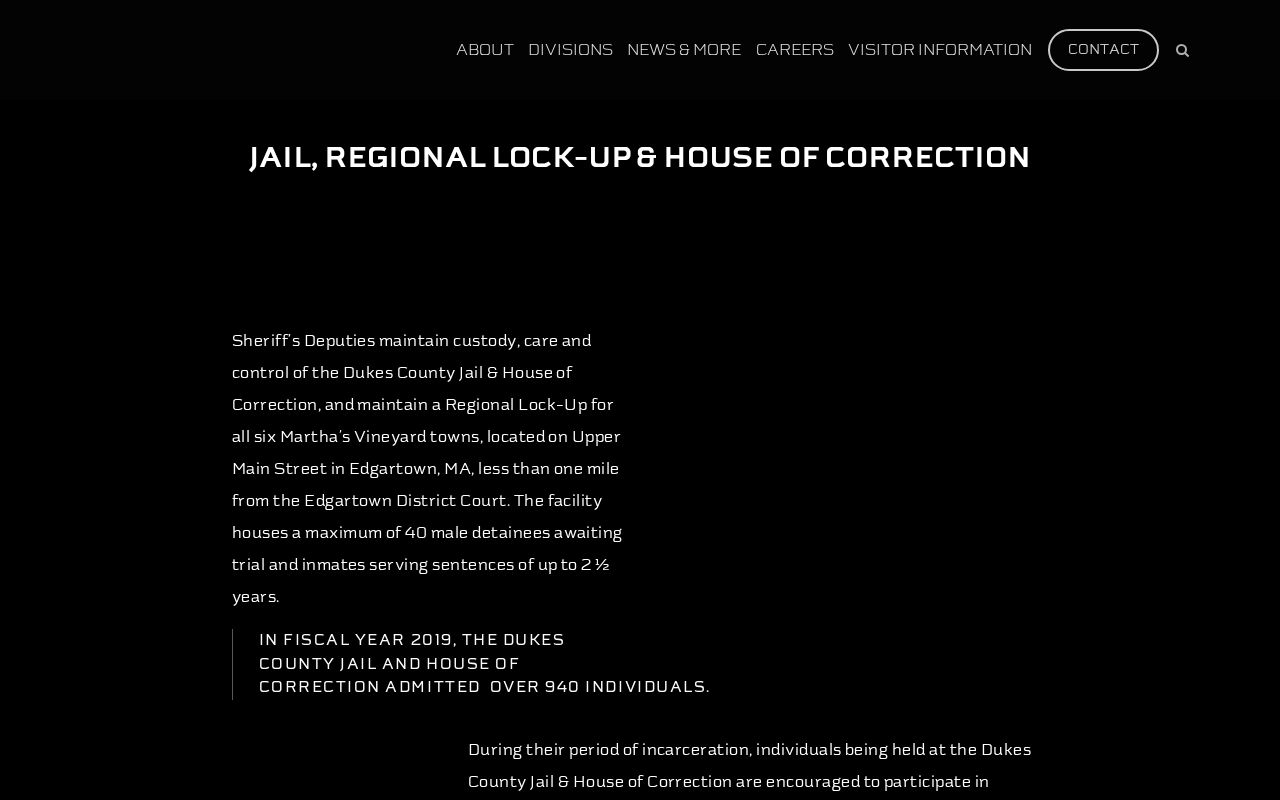
The sheriff's office offers background on the jail itself, though Dukes County arrest rosters are not posted there.
Keep the handoffs separate. A police-log item does not prove jail acceptance, and an old booking does not prove anyone is still in custody.
No Public Dukes County Arrest Roster
The DCSO website, across its home, jail, visitor, news, postings, and public-records pages, publishes no arrest roster portal. So there are no search fields, result columns, photo flags, or refresh schedules to describe. A missing web result proves nothing either way. It does not show that no arrest happened. It does not show that anyone was released.
| Roster feature | Dukes County finding |
|---|---|
| Name or booking-number search | No verified public DCSO form |
| Current detainee results | No verified online result table |
| Booking photograph | No published DCSO display policy or gallery |
| Update and removal timing | No public schedule or persistence rule |
| Mobile jail app | No verified DCSO inmate-lookup application |
A short verification chain works better. Start with the town and the approximate date. Then call DCSO at 508-627-5173 for the current-custody route. For older events or documents, email a narrow written request to records@dcsoma.org. The court record settles the case outcome. DCSO social accounts sometimes carry announcements, but they are not booking feeds. The Massachusetts Sheriffs Association profile offers agency context and social links.
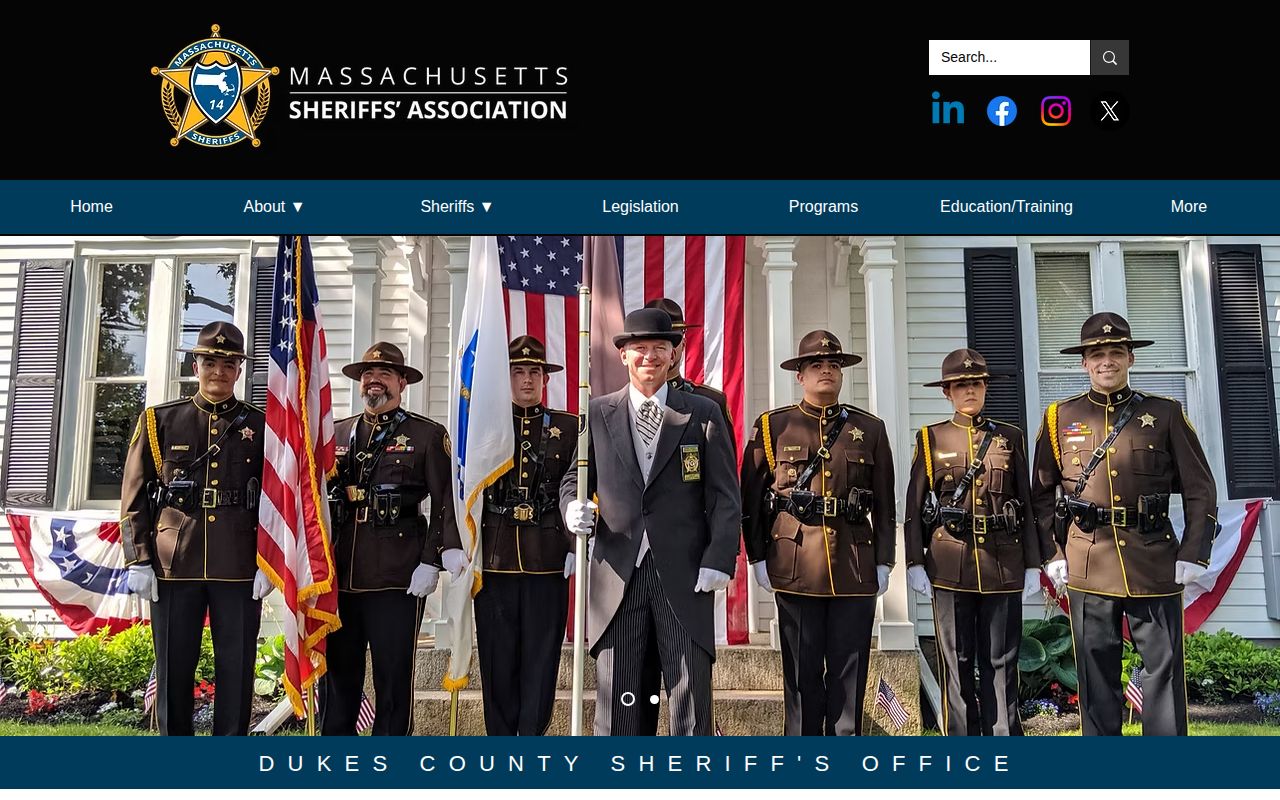
The profile helps confirm official channels, not who is in the jail.
Where Dukes County Arrest Information Appears
Official sources come first because each controls one piece of the record. Local news adds context. Private directories may be stale or incomplete.
| Channel | Photo? | Status | Best use |
|---|---|---|---|
| DCSO phone and records officer | By specific request, subject to review | Official | Current custody and county booking files |
| Edgartown weekly incident PDFs | No standard field verified | Official town | Dated Edgartown police activity |
| Oak Bluffs administrator reports | No standard field | Official town | Mixed police activity in periodic reports |
| Tisbury daily-log file share | No field verified | Official town | Dated Tisbury police activity |
| District Court and MassCourts | Not a photo repository | Official court | Arraignment through disposition |
| Vineyard Gazette Police/Court | Story images vary | Independent news | Rolling island police and court reporting |
| Mugshots.com Dukes directory | Copied images may appear | Unofficial, possibly stale | A lead requiring official verification |
| MA Arrests Dukes page | No live feed verified | Unofficial directory | Secondary background only |
Busted Newspaper, RecentlyBooked, Arrests.org, and Mugshots.zone list no Dukes County section. A root page for those sites is not evidence of county coverage. And a private directory entry cannot tell you whether DCSO still holds a person.
Recent Arrests by Dukes County Town
Municipal logs are the closest thing to a dated public activity stream, though every town formats them differently.
- Oak Bluffs Recent Arrests explains police entries nested in Town Administrator reports and the town records form.
- Edgartown Recent Arrests covers weekly incident PDFs, its records officer, and the county-seat court handoff.
- Tisbury Recent Arrests explains the Vineyard Haven daily-log file share and town request route.
Aquinnah, Chilmark, and West Tisbury use the same countywide custody system, even though they sit outside the top-three page set. Whatever the town, confirm jail custody through DCSO. Never read continued detention into a police entry alone.
Inside a Dukes County Booking Record
Booking is correctional intake, done after delivery to the facility. Massachusetts rules name the categories used in intake and identification records. DCSO exposes no public field-by-field results page. A released copy may leave out protected material. So treat this inventory as a request guide rather than a promise of full disclosure.
| Field | What it can show |
|---|---|
| Identity and identifiers | Name, identifying details, and an internal booking reference |
| Timing | Delivery, intake, court, transfer, release, or discharge events |
| Delivering agency | The town police department or other delivering agency |
| Booking charges | Charges at intake, subject to amendment or dismissal |
| Court and process | Complaint, mittimus, bail, warrant, or related process |
| Custody movement | Acceptance, cell placement, discharge, or transfer data |
| Identification photograph | An intake image may exist, though release is not guaranteed |
Some parts of a booking record stay protected. Medical details, victim information, emergency contacts, and juvenile material are typically withheld or redacted. The same goes for sealed or expunged content. Instead of expecting a full release, ask for the segregable portions that are not exempt.
A few terms carry weight here. Booking is simply jail intake, arraignment is the first court stage on a charge, and bail sets the conditions of release. Disposition is the final result. Expungement is a narrow statutory process, entirely separate from sealing.
Dukes County Mugshots and Arrest Photos
Where do booking photos come from in Massachusetts? Photographs can be taken during correctional identification. M.G.L. c.127 §28 gives jail-record context, M.G.L. c.263 §1A covers identification tied to felony arrests, and 103 CMR 918.04 lists a photograph among booking and intake information. None of that requires the DCSO to keep a public gallery. The Sheriff's office posts no photo endpoint, no automatic publication policy, and no display period.
Want an image? Identify the person, the date range, the arresting agency, and the booking number if you have it. File separate requests for the booking record and the photograph, ask for electronic delivery, and request the legal basis if anything is withheld. Keep in mind that a police-held image is not always the DCSO intake photo. For a sentenced state prisoner, the Massachusetts DOC holds internal identification records. Its public VINELink search is only a status locator. It has no public photo field.
A booking photograph documents an identification event. Republishing one without need can compound privacy and accuracy harm.
Request a Dukes County Arrest Record
Written requests are preferred on the DCSO public-records page. Special Sheriff Kayla Pachico serves as Records Access Officer. Contact details there include 149 Main Street, Edgartown, MA 02539, PO Box 252, records@dcsoma.org, 508-627-5173, and fax 508-627-8496. The office posts no special photo form, fixed price, or guaranteed completion time.
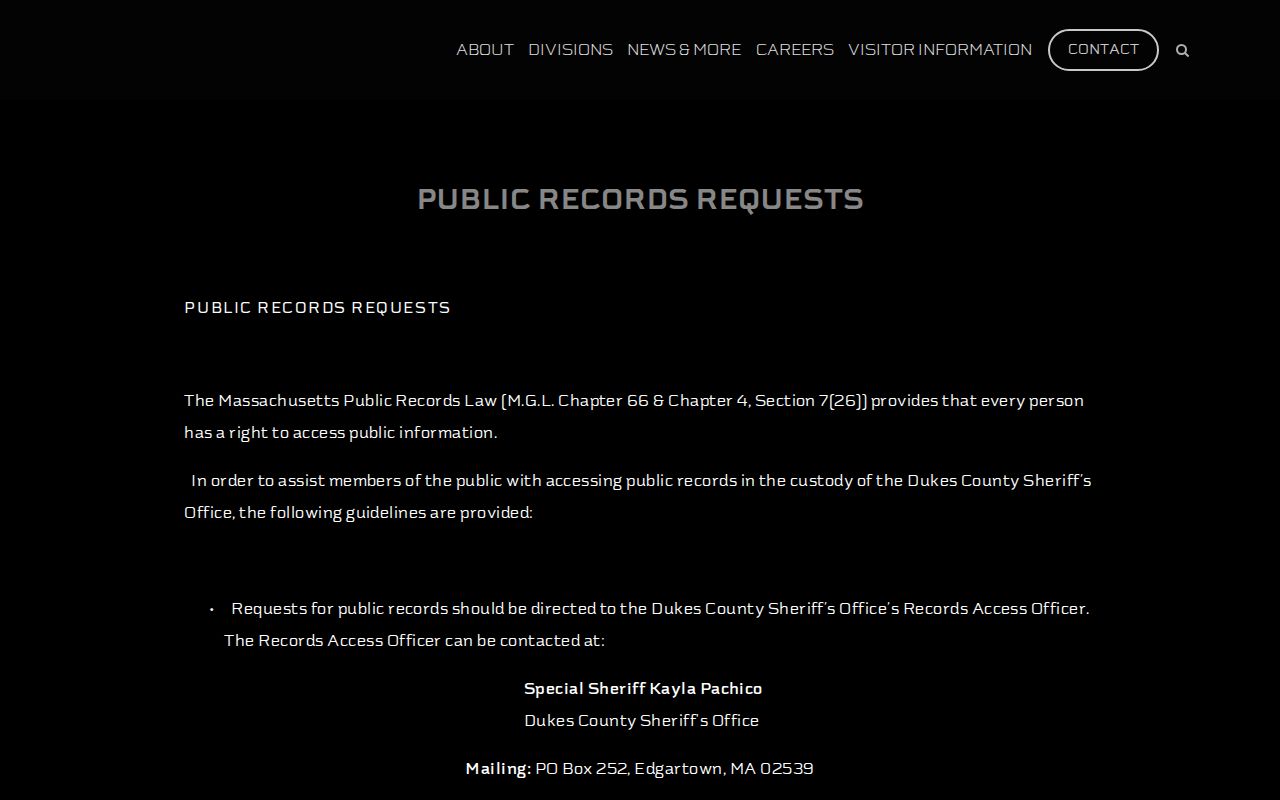
The official page shows the documented route and warns that reasonable fees may apply.
- Give the full name and known spelling variations.
- State a focused date range and delivering town agency.
- Name the booking record and photograph as separate items.
- Add a booking or court docket number when available.
- Ask for electronic copies and an itemized estimate.
- Request segregable non-exempt portions and the basis for denial.
What can a request yield? Massachusetts law can lead to inspection, copies, redaction, an estimate, partial production, or a written denial. Fees depend on the request and the work involved. Skip broad gallery requests and any protected medical, victim, juvenile, or third-party data.
Massachusetts Arrest Records and Removal Law
M.G.L. c.66 §10 sets the general access framework. It works alongside the public-record definition and exemptions in M.G.L. c.4 §7(26). Public does not mean posted online, unredacted, or free to republish. Massachusetts has no broad mugshot-publication or anti-pay-to-remove statute on the books. Criminal-history rules, juvenile confidentiality, privacy exemptions, court access, sealing, and expungement all matter. Each can shift what is available.
Four distinct remedies exist. Source correction fixes an error, sealing restricts qualifying records, and expungement follows a narrower statutory path. Search-index updating simply refreshes a stale result once the source changes.
Sealing has an official sealing guide, and M.G.L. c.276 §100A spells out eligibility. Commonly cited waiting periods run three years for an eligible misdemeanor and seven years for an eligible felony from the applicable completion point. Other limits apply. The official expungement path under M.G.L. c.276 §§100E through 100U is narrower still. Neither process guarantees that copied pages or cached snippets vanish.
Start with the agency that created the record, plus official court forms. If a private page is wrong, use its free correction process when offered and supply source proof. Avoid paid-removal intermediaries. After a source changes, a search engine can refresh its index, but it cannot delete a live source.
How Long Dukes Booking Records May Last
How long do booking records last? The March 26, 2026 Massachusetts Statewide Records Retention Schedule offers the best sourced model. The DCSO must confirm its local implementation. It gives permanent treatment to commitment and discharge logs, plus some fingerprint-card and photograph series. Some central case and house-of-correction records get six-year periods followed by electronic handling. Retained never means online or publicly releasable.
Chasing an old record? Ask the DCSO records officer which series applies. Confirm whether the date range was migrated, destroyed under an approved schedule, or transferred. Also ask whether a public portion can be separated. Material sent to the Massachusetts Archives requires the agency, facility, record type, year, and person. Include any known series number too. Historic court cases follow their own archives path.
Dukes County Arrest Warrants and Most Wanted
The DCSO maintains no public warrant portal, countywide warrant list, most-wanted gallery, local Crime Stoppers page, or Sheriff reward program. That gap concerns web access only. Warrants still exist. DCSO news and postings are agency notices, not a substitute list.
For a lawful inquiry, use the Edgartown District Court clerk, the relevant town police, or an attorney. M.G.L. c.276 §29 describes official checks during covered bail or release processing, but that system is not public. Never approach, follow, threaten, or try to detain someone over an online claim. Pass information to police. Use 911 only for immediate danger.
After a Dukes County Arrest
After an arrest in Dukes County, the court trail usually runs through Edgartown District Court at 81 Main Street. The case may involve complaint issuance, arraignment, bail, pretrial events, motions, continuances, a plea, dismissal, trial, sentencing, or a move to another court. Serious matters can land in Dukes County Superior Court. A police log captures only an early event. A jail inquiry shows custody at one moment. The MassCourts eServices portal is the official online starting point.
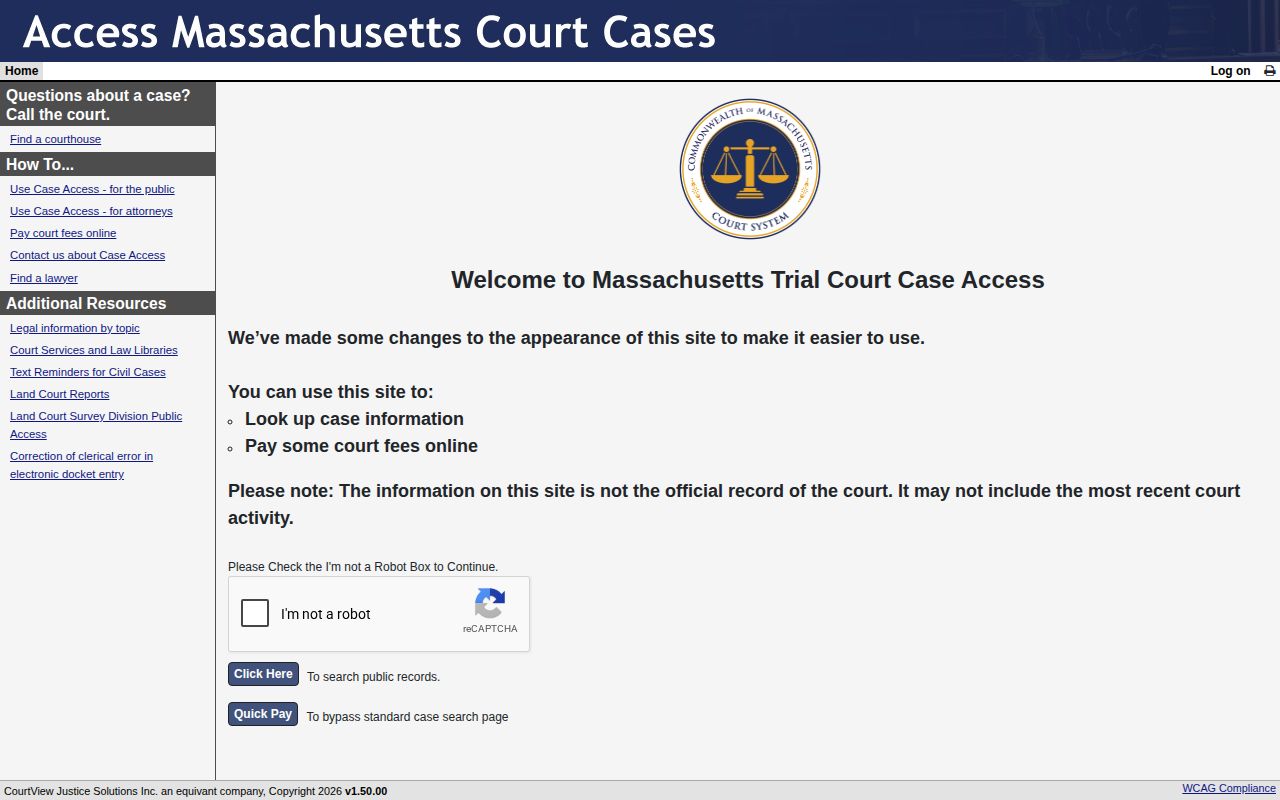
Remote criminal access can be limited, so a case number, a courthouse inquiry, or a public kiosk may be needed.
Check the current docket. The disposition shown there reflects how a case actually stands.
State, Federal, and Immigration Custody
State custody runs through a different pipeline. The Massachusetts Department of Correction locator points to VINELink for anyone held in state DOC custody, and it accepts a full name or a commitment number. That tool is not a Dukes County roster. Only Massachusetts DOC participates in Massachusetts VINE, so a dead-end search there says nothing about a local Dukes County arrest. The confidential Massachusetts Victim Notification Registry sits apart as well, with its own eligibility and registration rules.
Federal systems cover yet other populations. The BOP locator tracks federal prison custody and shows no public booking photo gallery. PACER follows federal court dockets. The ICE Online Detainee Locator handles immigration detention, and DCSO lists no routine local ICE booking feed. Each system answers only its own question.
Dukes Arrest Admissions in Context
DCSO counted more than 940 admissions in fiscal year 2019. That number measures facility intake in one period. It is not a live tally of Dukes County recent arrests. It tells you nothing about today's jail population. You learn nothing about how many people sit in custody right now. Nor does it show whether arrests trend up or down. The regional lock-up serves pretrial custody along with other county correctional functions. An admission therefore never equals a conviction.
Older county material cites a different fiscal-year figure. Matching definitions and matching years matter before any comparison makes sense. For a question about a specific person today, ask DCSO directly. For a historical series, request the exact reporting period and the measure behind each count.
Historic Dukes Jail Record Context
The DCSO news archive covers repair and replacement work on the current 1873 jail. The regional lock-up appears too. That history explains why infrastructure and record systems shift over time. It offers no roster, no photo policy, and no posting schedule. The building's age proves nothing about any present detainee. Nor does it time a particular booking.
Records often outlive the systems that first stored them. A focused archive search or a DCSO request should name the record series. Include its date as well. The facility's own history is no guarantee that a document still exists.
Dukes Arrest Transport Record Trail
The Sheriff's regional duties include transport to courts and other facilities. One island arrest can leave a trail across several offices. A town police entry, a regional-lock-up booking record, and a court docket may each appear at different times. A later transfer record may surface on its own schedule as well. Movement off island can also explain why someone no longer shows in DCSO custody. The original booking stayed with the Sheriff either way.
No source fixes a ferry schedule, transfer delay, or booking lag for every case. So check the custodian tied to each stage. Town police hold the encounter report. DCSO holds local intake and discharge. The court holds the case, and the receiving agency holds later custody.
Town Records Behind Recent Arrests
Each town keeps its own formal records route. Direct a request to the office that created the record. Edgartown has the clearest police-specific process. Its records page names Records Access Officer Ken Romero, lists 508-627-4343 extension 26 and kromero@edgartown-ma.us, and posts weekday office hours from 8:00 a.m. to 4:00 p.m. Expect up to 10 business days for processing or acknowledgment, with fees or redactions possible. That route serves an Edgartown police report or police-held photograph, not a guaranteed DCSO booking image.
Oak Bluffs offers an online form and a public-records page, with Wendy Brough named at 508-693-3554 extension 149 and wbrough@oakbluffsma.gov. Tisbury lists Town Clerk Hillary Conklin at 508-696-4215 and accepts online or PDF submissions; for a Tisbury police record, 508-696-4240 is the practical first call. A strong request states the event, the date, the department, and the exact report or image sought.
These channels do not replace DCSO. Town police may have created the incident report while the Sheriff created the intake record, so two requests may be needed. That same division explains why a town log can show a summons or protective-custory event that never becomes a county booking. Ask each custodian only for what it likely holds.
When a Dukes Arrest Record Is Withheld
A missing online result has many causes. DCSO may hold a record it never published. A public copy may require redaction. Juvenile, sealed, expunged, victim, medical, emergency-contact, and safety-sensitive records can all be restricted. Massachusetts court rules treat remote access differently from courthouse access. None of these outcomes invites a guess or a private workaround.
When an agency withholds a responsive record, ask for the legal basis. Ask also for any segregable public portion. When MassCourts blocks the desired remote search, turn to the official docket guidance. The court clerk or a courthouse visit works too. A restricted complaint, an absent name, or a removed page settles nothing on its own.
Reading Charges After a Dukes Arrest
A booking charge reflects what officers entered when a person was arrested in Dukes County. It is only the first entry. The case then belongs to the court. Docket sheets may later show a reduced charge, a dismissal, a nolle prosequi, a plea, or an acquittal, so the label on a recent arrest rarely settles the outcome. When a news item or an online directory repeats an old charge, check the current docket before treating that booking entry as final. Edgartown anchors this paper trail as the county seat. The jail and the District Court sit within the same Main Street county system, yet they keep separate records and separate jobs. The clerk handles court files and procedure. The sheriff's office answers for booking and custody, not for how the case ends.
For dated entries from town police, the Police Blotter collects them in one place. Suspect someone moved to state custody? The VINELink Custody Check walks through the search and its Dukes County limits.
Dukes County Sheriff’s Office Location and Directions
Public Record Search
Sponsored Results
Dukes Arrest Announcements on Social
The Massachusetts Sheriffs Association directory lists DCSO accounts on Facebook, X, and YouTube. Those channels can carry agency news or public notices. None is a booking feed. No account posts every new arrest, offers a name search, or follows a fixed photo schedule. A social post may announce an event without showing whether the person is still in the regional lock-up. Treat these accounts as a secondary channel. For a custody or booking question, return to the DCSO control desk or the Records Access Officer. The sheriff's office lists no inmate-search mobile app. An unrelated correctional app is not the Sheriff's system.